The history of the Times Square Ball Drop stretches back more than a century, to a newspaper publisher who wasn’t allowed to set off fireworks. What started in 1907 as a workaround for a city fireworks ban has grown into the single most-watched New Year’s Eve tradition in the world, broadcast to roughly a billion viewers and packing hundreds of thousands of people into Midtown Manhattan every December 31st. This guide walks through how the ball drop started, how the ball itself has changed over eleven decades, and how the tradition became the centerpiece of New York’s New Year’s Eve.
If you’re planning to see it in person, our best time to visit Times Square guide and our hotels with a view of Times Square guide are the practical companions to this one.
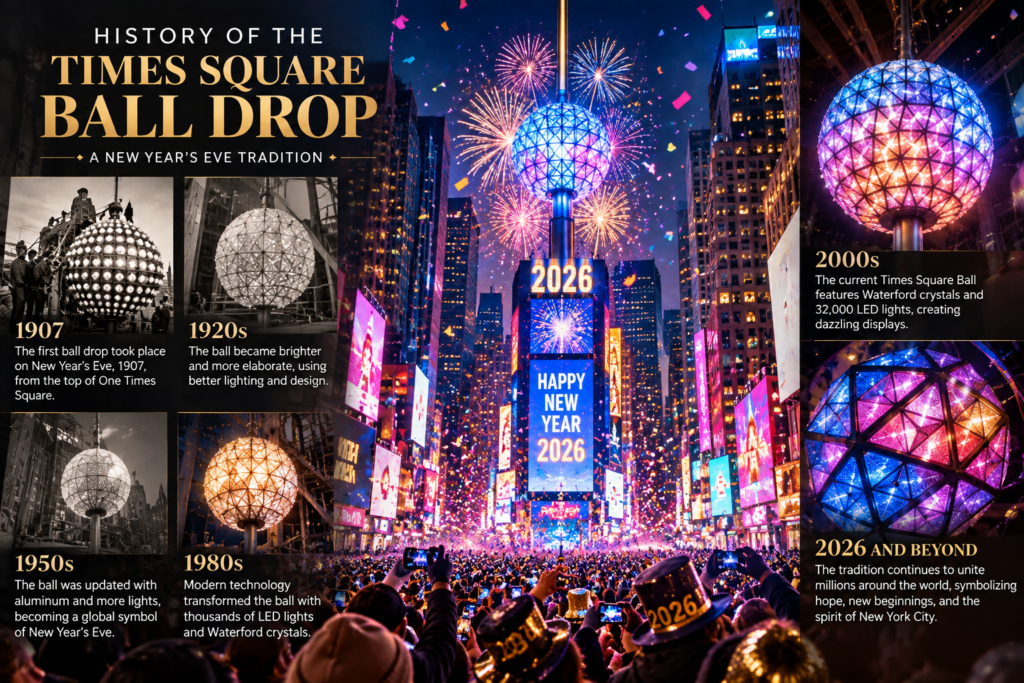
How the Times Square Ball Drop Started
The history of the Times Square Ball Drop begins not with a ball, but with fireworks. Adolph Ochs, publisher of The New York Times, had moved the paper’s headquarters to what was then called Longacre Square in 1904 and wanted a spectacle to draw attention to the new building. On New Year’s Eve that year, workers launched a rooftop fireworks display so large it reportedly lit up the entire structure from base to dome.
The fireworks display only ran for two more years before New York City outlawed the practice on safety grounds. Rather than abandon the celebration, Ochs turned to sign maker Artkraft Strauss for a substitute: a large, illuminated ball that could be lowered down the building’s flagpole at midnight, visible to the crowds already gathering below. The idea borrowed from a much older maritime tradition — time-balls had been dropped daily at the Royal Observatory in Greenwich since the 1830s so ships could set their clocks.
The First Ball Drop: December 31, 1907
The first Times Square Ball Drop took place at midnight on December 31, 1907, marking the arrival of 1908. That original ball was a far cry from today’s crystal sphere — a 700-pound frame of iron and wood, five feet in diameter, wrapped in wood and studded with 100 incandescent light bulbs. It was lowered by hand, pulley by pulley, by a small team of workers stationed on the roof.
The event was an immediate hit. Crowds poured out of the subway stations around the square, and by the time the ball reached the bottom of the pole, the celebration had cemented Times Square as New York’s default gathering place for New Year’s Eve — a status the neighborhood has never lost.
How the Ball Has Changed: A Timeline
The Times Square Ball Drop tradition has been rebuilt several times since 1907, each version reflecting the technology and design sensibility of its era.
| Year | What Changed |
|---|---|
| 1907 | First ball drop: iron and wood, 700 lbs, 100 light bulbs |
| 1920 | New ball built entirely from iron, dropping the wood frame |
| 1942–1943 | Ball drop suspended during WWII due to citywide wartime lighting restrictions |
| 1955 | Aluminum ball introduced, cutting the weight to around 150 lbs |
| 1995 | Aluminum ball updated with rhinestones, strobe lights, and a computer-controlled lighting system |
| 1996 | Descent automated for the first time after an incident involving the manual rope system |
| 2000 | Waterford Crystal panels added for the millennium celebration |
| 2007 | New LED-illuminated crystal ball introduced for the drop’s 100th anniversary |
| 2008 | Current 12-foot, six-ton ball debuts, covered in 2,688 Waterford Crystal triangles |
| 2009 | Ball made a permanent, year-round fixture atop One Times Square |
The World War II Blackout Years
The only interruption in the ball drop’s history came during World War II. In 1942 and 1943, New York enforced a wartime lighting restriction, and the Times Square Ball Drop was suspended along with it. Crowds still gathered in the square both years, marking midnight with a minute of silence followed by chimes from sound trucks rather than a lit ball descending the pole — a quieter tradition that ended as soon as the lighting ban was lifted in 1944.
From Rope and Pulley to Computer-Controlled Descent
For most of the twentieth century, the ball was lowered manually by a small crew pulling on ropes from the roof of One Times Square, timed by eye to hit the bottom of the pole exactly at midnight. That changed in 1996, when the descent was automated after a worker became tangled in the ropes mid-drop, forcing an unplanned pause. Since then, the ball’s 60-second descent has been controlled electronically, synced precisely to the atomic clock countdown broadcast to the crowd.
The Modern Ball: Waterford Crystal and LEDs
The ball used today dates to 2008, built for the drop’s centennial the year before. It measures 12 feet in diameter, weighs roughly six tons, and is covered in 2,688 Waterford Crystal triangles arranged in a geodesic pattern, lit from within by tens of thousands of LEDs capable of producing millions of color combinations and patterns. Unlike earlier versions that were assembled and disassembled each year, this ball has remained on permanent display atop One Times Square since 2009, illuminated year-round as a rooftop landmark rather than a once-a-year prop.
Waterford Crystal has designed a new set of triangles for the ball nearly every year since 2000, each cut with a different pattern tied to an annual theme — resilience, hope, courage, and similar ideas chosen to reflect the tone of the year. That design refresh has become as much a part of the modern tradition as the drop itself.
Why Times Square Became the Home of New Year’s Eve
The Times Square Ball Drop’s history is tied directly to the neighborhood’s identity. Before 1904, New York’s main New Year’s Eve gathering point was lower Manhattan, near Trinity Church, where crowds gathered to hear the church bells ring in the new year. Ochs’s fireworks display — and later the ball drop — pulled that tradition north to Longacre Square, which the city officially renamed Times Square that same year in honor of the newspaper’s new headquarters. The annual crowds the ball drop generated helped turn the intersection into the commercial and cultural hub it remains today.
How the Ball Drop Works Today
The modern ceremony follows a script refined over decades. The ball is raised to the top of a 130-foot pole atop One Times Square in the late afternoon on December 31st, ahead of a night of live performances broadcast from stages set up throughout the square. At 11:59 p.m., the ball begins its 60-second descent, timed to reach the bottom of the pole exactly at midnight, triggering a burst of confetti and fireworks that marks the start of the new year on live television and streaming broadcasts worldwide.
If you’re planning to watch the ball drop itself rather than just visiting the neighborhood, viewing areas along Broadway and Seventh Avenue typically begin filling in the early afternoon, and pedestrian pens close once they reach capacity — arriving early is the only reliable way to get a usable view. Our first-time visitor guide covers logistics for the square more broadly if this is your first trip.
Frequently Asked Questions
When did the Times Square Ball Drop start?
The first Times Square Ball Drop took place on December 31, 1907, marking the arrival of 1908. It was created by New York Times publisher Adolph Ochs after the city banned the fireworks displays he had previously used to celebrate the New Year.
Has the ball drop ever been cancelled?
The ball itself did not drop in 1942 and 1943 due to wartime lighting restrictions in New York City during World War II, though crowds still gathered in Times Square both years to mark midnight. Every other year since 1907, the ball has dropped as scheduled.
What is the Times Square Ball made of today?
The current ball, in use since 2008, is covered in 2,688 Waterford Crystal triangles and lit by LED lighting capable of producing millions of colors and patterns. It measures 12 feet across and weighs about six tons.
Is the Times Square Ball on display year-round?
Yes. Since 2009, the ball has remained permanently mounted atop One Times Square rather than being assembled and removed annually, and it’s illuminated year-round as a visible rooftop landmark.
How much did the original 1907 ball weigh?
The first ball weighed 700 pounds and was five feet in diameter, built from iron and wood and covered in 100 incandescent light bulbs — a fraction of the size and weight of the six-ton crystal ball used today.
Final Thoughts
The history of the Times Square Ball Drop is really the history of a workaround that outlasted the problem it solved — a fireworks ban that led to a tradition now watched by roughly a billion people every year. From a 700-pound iron-and-wood sphere lowered by hand in 1907 to today’s six-ton, crystal-covered, LED-lit landmark, the ball has changed almost beyond recognition, but its purpose has stayed exactly the same: giving New York, and the world, a single visible moment to mark the turn of the year. If you’re building out the rest of your NYE trip, our best time to visit Times Square guide and rooftop bars with Times Square views guide are good next stops.