Knowing how to get to Times Square before you leave your hotel or apartment saves you from the single most common mistake first-time visitors make: getting off at the wrong stop and walking ten extra minutes through the densest crowds in Manhattan. This guide covers every practical way to get to Times Square — subway, bus, car, rideshare, and on foot — along with current fares, which specific lines and stations actually put you closest to the action, and what to expect once you arrive.
If you’re still deciding when to visit, our best time to visit Times Square guide is a good starting point before you lock in travel plans.
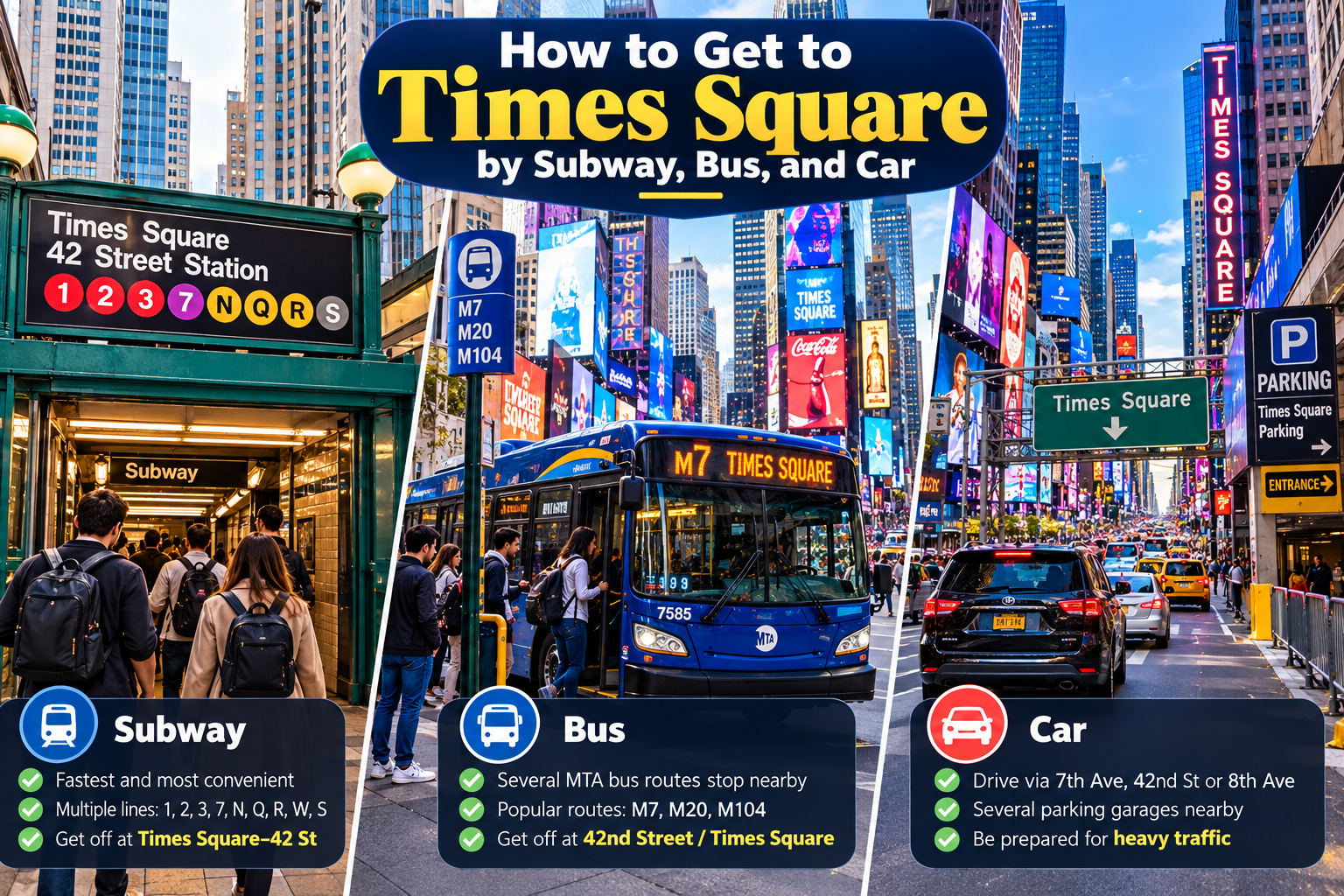
Quick Answer How to Get to Times Square: The Fastest Ways to Get to Times Square
| Method | Best For | Approx. Cost |
|---|---|---|
| Subway | Fastest, cheapest option for most trips | $3.00 per ride |
| Local bus | Above-ground routes, no direct train nearby | $3.00 per ride |
| Rideshare/taxi | Late nights, heavy luggage, groups of 3+ | $15–$40 depending on distance and traffic |
| Walking | Already in Midtown, within 15–20 blocks | Free |
| Driving your own car | Rarely recommended; only if no other option exists | $20–$60+ for parking, plus a $15 congestion toll during peak hours |
For nearly everyone, the subway is the single best way to get to Times Square. The rest of this guide breaks down exactly how to use it, along with every backup option.
How to Get to Times Square : Getting to Times Square by Subway
The subway is the fastest and most reliable way to get to Times Square, and the neighborhood is served by one of the busiest station complexes in the entire New York City subway system: Times Sq–42 St. This single complex sits directly under the square at the intersection of 42nd Street, Seventh Avenue, and Broadway, so getting off here puts you right in the middle of the billboards rather than several blocks away.
| Subway Lines | Station | Runs |
|---|---|---|
| 1, 2, 3 | Times Sq–42 St | All times |
| N, Q, R, W | Times Sq–42 St | All times (W weekdays only) |
| 7 | Times Sq–42 St | All times |
| S (42nd St Shuttle) | Times Sq–42 St | All times except late night |
| A, C, E | 42 St–Port Authority Bus Terminal | All times (one block west) |
| B, D, F, M | 42 St–Bryant Park | All times (one block east) |
If you’re coming from Grand Central Terminal, the S shuttle is the single fastest way to get to Times Square — it’s a direct, one-stop ride with no transfers, and trains run every few minutes throughout the day. If you’re arriving from Brooklyn or Queens, the N, Q, or R lines run straight into the station without requiring a change of trains. Travelers coming from Upper Manhattan or the Bronx will usually find the 1, 2, or 3 express and local trains most convenient, since they run the length of Seventh Avenue and Broadway before reaching the square.
For live service changes, always check the MTA’s official site before you head out — weekend service changes are common on the New York City subway, and a line that normally stops at Times Square can be rerouted without much notice, especially overnight and on weekends when track work is scheduled.
Which Exit Should You Use?
The Times Sq–42 St complex has several exits, and picking the right one matters more than it sounds. The Broadway Plaza entrance, rebuilt in 2022 with a new staircase and elevator, opens directly onto the pedestrian plaza in the heart of the square — this is the exit most first-time visitors want. Exits closer to Seventh Avenue and Eighth Avenue put you a block or two off-center, which is useful if you’re heading to a specific theater or hotel rather than the billboards themselves. If you’re unsure, following signage toward “Broadway” rather than “Seventh Avenue” or “Eighth Avenue” will generally land you closest to the main viewing area.
What It Costs: Current MTA Fares
As of 2026, the MTA has moved entirely to OMNY, its contactless tap-and-pay system, and has phased out MetroCard. You can pay by tapping a contactless credit or debit card, a smartphone wallet, or an OMNY card purchased at a station vending machine or participating retailer.
| Fare Type | Price |
|---|---|
| Subway or local bus, single ride | $3.00 |
| Weekly fare cap (unlimited after 12 rides in 7 days) | $35.00 |
| Express bus, single ride | $7.25 |
| Weekly express bus fare cap | $67.00 |
The weekly fare cap is automatic — there’s nothing to sign up for. Tap the same card or phone for 12 rides within a rolling seven-day period, and every ride after that is free for the rest of that week. This effectively works like an unlimited weekly pass without needing to buy one in advance, and it’s the cheapest way to get to Times Square repeatedly if you’re staying in the city for several days.
Getting to Times Square by Bus
Bus service is a slower way to get to Times Square than the subway, but it’s a useful option if you’re coming from a neighborhood without a direct train line, if you have mobility needs better served by a bus’s low floor and ramp access, or if you’d rather stay above ground and watch the city go by instead of riding underground.
- Local buses: Several local routes run through or near Times Square along the north-south avenues and connecting crosstown streets.
- Express buses: Multiple express routes connect Staten Island, Queens, and the Bronx to Midtown Manhattan, generally stopping within a short walk of the square.
Because express bus routes and stop locations are adjusted periodically, check the current route map on the MTA’s official site for the exact route number and stop nearest your starting point before you travel. Local buses accept the same OMNY tap payment as the subway, and a free transfer between bus and subway is included within a set time window, so switching between the two doesn’t cost extra beyond the base fare.
Arriving by Intercity or Commuter Bus
If you’re traveling to Times Square from outside the city — on a Greyhound, Megabus, or a regional commuter line — you’ll most likely arrive at the Port Authority Bus Terminal on 42nd Street and Eighth Avenue, which is a flat, roughly four-block walk east to reach the heart of Times Square. The terminal also connects directly to the A, C, and E subway lines if you’d rather ride the last stretch than walk it, particularly useful if you’re carrying luggage. Full schedules and terminal maps are available on the Port Authority’s official site.
Commuter rail travelers arriving at Penn Station (34th Street) or Grand Central Terminal (42nd Street) are both within easy reach of Times Square as well. From Penn Station, it’s roughly a 10-to-15-minute walk north on Seventh or Eighth Avenue, or a short ride on the 1, 2, or 3 train. From Grand Central, the 42nd Street Shuttle is the most direct option, taking you straight to Times Sq–42 St in a single stop.
Getting to Times Square by Rideshare or Taxi
Rideshare apps and yellow taxis are widely available throughout Manhattan and can be a reasonable way to get to Times Square, particularly late at night when subway frequency drops, when you’re traveling with heavy luggage, or when you’re in a group of three or more where the per-person cost of a ride starts to compete with individual subway fares.
That said, traffic around Times Square is dense at almost every hour, and a rideshare drop-off directly on Broadway or Seventh Avenue is often illegal or impractical due to pedestrian barriers, especially during peak tourist hours. Most drivers will drop you a block or two away on a side street, so budget a short walk regardless of which car service you use. Surge pricing is also common in this area during evening rush hour, weekend nights, and around major events, so checking the fare estimate before confirming a ride is worth the extra few seconds.
Getting to Times Square by Car and Where to Park
Driving is the least practical way to get to Times Square, and it’s worth saying plainly: traffic in Midtown is dense at nearly every hour, street parking near the square is scarce to nonexistent, and most New Yorkers avoid driving here entirely. If you’re arriving from outside the city and have no better option, plan for a parking garage rather than street parking, and build extra time into your schedule for traffic.
- Book a garage in advance. Apps like SpotHero and ParkWhiz let you reserve a spot at a fixed rate, which is almost always cheaper than pulling into a garage and paying the drive-up price.
- Look one or two blocks off the square. Garages directly on Broadway or Seventh Avenue charge a premium; walking a couple of extra blocks can cut the price significantly, sometimes by half.
- Avoid arriving Friday or Saturday evening. Weekend nights combine theater traffic, tourist traffic, and reduced parking availability all at once, and prices tend to climb accordingly.
- Consider parking outside Manhattan. Some visitors park at a garage near a subway station in Queens, Brooklyn, or New Jersey and ride the train in the rest of the way, which is often faster overall than driving all the way into Midtown, especially during rush hour.
- Factor in the congestion toll. Manhattan below 60th Street, which includes Times Square, is inside the Congestion Relief Zone. Passenger vehicles pay a $15 toll during peak hours (5 a.m.–9 p.m. weekdays, 9 a.m.–9 p.m. weekends), charged once per day regardless of how many times you enter or exit, with a reduced rate overnight.
Getting to Times Square from the Airports
All three major airports serving New York connect to Times Square without needing a car, and each route is fairly straightforward once you know the transfer point.
- From LaGuardia (LGA): Take the Q70 bus to the 74 St–Broadway/Roosevelt Ave station, then transfer to the E, M, or 7 train toward Manhattan.
- From JFK: Take the AirTrain to Jamaica Station, then the E train directly into Midtown, or transfer to the A train toward 42nd Street–Port Authority.
- From Newark (EWR): Take the AirTrain to Newark Airport Station, then an NJ Transit train into Penn Station, which is roughly a 10-minute walk or one subway stop from Times Square.
Rideshare and taxi service is also available from all three airports directly to Times Square, though fares run considerably higher than transit and travel time can be longer than the train during rush hour due to congestion on the approaches into Manhattan. Check current AirTrain fares directly on each airport’s official site, since these are billed separately from standard MTA subway fare.
Walking to Times Square from Nearby Landmarks
If you’re already staying in Midtown, walking is often the simplest way to get to Times Square, and several major landmarks are close enough to make the trip on foot practical rather than a hike.
- From Rockefeller Center: About a 10-minute walk south on Sixth Avenue, then west on 47th or 48th Street.
- From Bryant Park: Roughly 5 minutes west along 42nd Street.
- From Grand Central Terminal: About 15–20 minutes on foot along 42nd Street, or a single stop on the shuttle if you’d rather not walk.
- From Penn Station: Around 10–15 minutes walking north on Seventh or Eighth Avenue.
- From the Empire State Building: Approximately 15 minutes walking north on Fifth or Sixth Avenue and then west.
Sidewalks around Times Square itself get extremely crowded, particularly between 11 a.m. and 10 p.m., so budget extra time for walking the last block or two compared to a normal city block pace.
Accessibility Notes for Getting to Times Square
The Times Sq–42 St subway complex has elevator access at several entrances, including the Broadway Plaza entrance added during the 2022 renovation, making it one of the more accessible major stations in the system. That said, not every entrance has an elevator, and some transfers within the complex still require stairs, so travelers using a wheelchair or with mobility limitations should check the MTA’s accessibility map before choosing an entrance. Local buses are a reliable accessible alternative, since all New York City buses are equipped with low floors and ramps. Rideshare and taxi services remain the most flexible accessible option for door-to-door travel, though curb space directly at the square is limited.
Tips for First-Time Visitors
- Use OMNY, not MetroCard. MetroCard is being phased out; tap a contactless card, phone wallet, or OMNY card at the turnstile instead.
- Avoid rush hour if you can. Weekday travel between 7–9 a.m. and 4:30–6:30 p.m. is significantly more crowded on both trains and sidewalks around Times Square.
- Keep valuables secure in crowds. Times Square is generally safe, but dense crowds are a common spot for pickpocketing in any major city — keep bags zipped and phones in front pockets.
- Don’t rely on street parking. Metered spots near Times Square are rare and heavily enforced; assume you’ll need a garage if you’re driving.
- Download an offline map. Cell service can be inconsistent underground in the subway, so having your route saved offline avoids getting stuck without directions mid-transfer.
Getting Around Once You’re There
Once you’ve arrived, Times Square itself is walkable, and most of the nearby attractions, theaters, and restaurants are within a five-to-ten-minute walk of the subway complex. If your trip includes a Broadway show, note that the theater district spreads from about 41st to 54th Street between Sixth and Ninth Avenues, so double-check your theater’s exact address rather than assuming it’s directly on the square — our pre-theater dinner guide covers timing your meal around a showtime once you’re in the neighborhood.
Frequently Asked Questions
What subway line goes to Times Square?
The Times Sq–42 St station is served by the 1, 2, 3, 7, N, Q, R, W, and S (42nd Street Shuttle) trains, making it one of the best-connected stations in the entire subway system.
How much does it cost to get to Times Square by subway?
A single subway or local bus ride costs $3.00 as of 2026, paid via OMNY tap-and-pay. After 12 rides within a rolling seven-day period, additional rides are free for the rest of that week, up to a $35 weekly cap.
Is it easy to get to Times Square from JFK Airport?
Yes. Take the AirTrain to Jamaica Station and transfer to the E train, which runs directly into Midtown Manhattan close to Times Square, with no additional transfers needed.
Should I drive to Times Square?
Driving is generally not recommended. Traffic is heavy at almost all hours, street parking is extremely limited, the area falls inside Manhattan’s congestion pricing zone with a $15 peak-hour toll, and the subway or bus will almost always get you there faster and cheaper.
Where can I park near Times Square?
The most affordable option is booking a garage in advance through an app like SpotHero or ParkWhiz, ideally one or two blocks off Broadway or Seventh Avenue rather than directly on the square, where prices run highest.
How do I get to Times Square from Port Authority Bus Terminal?
It’s a flat walk of about four blocks east along 42nd Street, or you can take the A, C, or E train one stop and transfer to the 1, 2, 3, 7, N, Q, R, W, or S trains at the Times Sq–42 St complex.
Is the Times Square subway station wheelchair accessible?
Partially. Several entrances, including the Broadway Plaza entrance added in 2022, have elevator access, but not every entrance or transfer point within the complex is accessible, so checking the MTA’s accessibility map before you go is worthwhile.
How long does it take to walk to Times Square from Grand Central?
Around 15 to 20 minutes on foot along 42nd Street, though the 42nd Street Shuttle covers the same distance in a single, direct subway stop if you’d rather not walk.
Final Thoughts
Getting to Times Square is straightforward once you know which station to aim for: the Times Sq–42 St subway complex puts you directly under the billboards, while the Port Authority Bus Terminal and nearby Bryant Park station cover most bus and secondary subway connections. Skip the car if you can — between traffic, the congestion toll, and parking costs, it’s rarely worth it for a trip into Midtown. Once you’ve got the logistics sorted, our first-time visitor guide and best time to visit guide are the natural next stops for planning the rest of your trip.